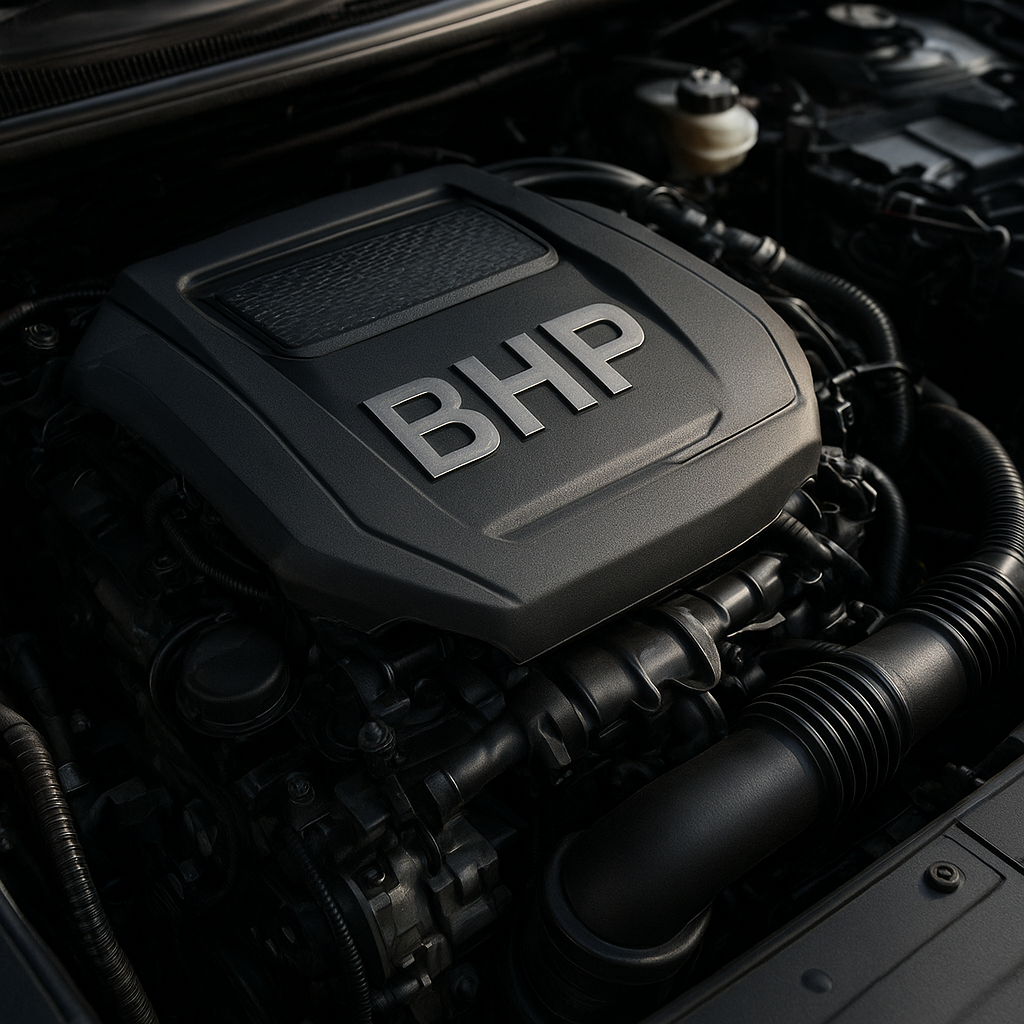
BHP stands for brake horsepower, a measurement of an engine’s mechanical power output obtained using a dynamometer. The word “brake” refers to the equipment used to apply resistance during testing, not the vehicle’s braking system. BHP indicates how much power an engine can produce, rather than how fast a car can travel. The term commonly appears in automotive specifications, particularly in the United Kingdom, while American manufacturers typically use horsepower (HP).
What Does BHP Stand for in Cars?
Brake horsepower measures the useful mechanical power an engine produces at its output shaft. It accounts for internal engine losses, such as friction, but does not include the additional power losses that occur when energy travels through the vehicle’s transmission and drivetrain to the wheels.
For example, if a car has an engine rated at 300 BHP, that figure describes its engine output under specified testing conditions. It doesn’t mean that all 300 horsepower reaches the road.
BHP is also different from torque. Torque describes rotational force, while horsepower measures how quickly work can be performed. Both characteristics influence how a vehicle accelerates and responds to the accelerator.
The term brake horsepower comes from the original method of measuring engine output using a braking device that applies controlled resistance.
How Is BHP Measured?
Engineers measure brake horsepower using a dynamometer, commonly called a dyno. During testing, the equipment places a controlled load on the engine while measuring torque at different engine speeds.
The basic process involves three steps:
- Applying resistance: The dynamometer creates a load against the rotating engine output shaft.
- Measuring torque and RPM: Sensors record rotational force and engine speed in revolutions per minute.
- Calculating horsepower: The measured values are used to determine mechanical power.
When torque is expressed in pound-feet, the standard calculation for mechanical horsepower is:
Horsepower = Torque (lb-ft) × RPM ÷ 5,252
For example, an engine producing 250 lb-ft of torque at 4,000 RPM generates approximately 190 horsepower at that operating point.
Actual test results depend on environmental conditions, engine accessories, and the measurement procedure. The SAE International engineering standards, including SAE J1349, establish standardized methods for rating engine power.
BHP vs. HP vs. WHP: What’s the Difference?
These three abbreviations are commonly used when discussing engine performance, but they don’t always describe measurements taken at the same location.
- BHP (Brake Horsepower): Mechanical power produced by an engine, typically measured at its output shaft using a dynamometer.
- HP (Horsepower): A general unit of power. In vehicle specifications, HP usually refers to the manufacturer’s rated engine horsepower.
- WHP (Wheel Horsepower): Power delivered to the driven wheels after losses through the transmission, differential, and other drivetrain components.
Wheel horsepower is generally lower than engine horsepower because some energy is lost through friction and other mechanical processes before reaching the wheels.
However, BHP and HP are not necessarily different physical units. Both can describe mechanical horsepower, and manufacturers may use the terms interchangeably when reporting engine output.
Differences in published figures may also result from testing standards or the use of metric horsepower (PS), which is slightly different from mechanical horsepower.
The Encyclopaedia Britannica’s explanation of horsepower provides additional background on this unit of power.
Does Higher BHP Mean a Faster Car?
Higher brake horsepower can improve acceleration and top-speed potential, but engine power alone doesn’t determine vehicle performance.
Several other factors matter:
- Vehicle weight: A lighter car generally requires less power to accelerate.
- Torque and power delivery: The engine’s output across different RPM ranges affects performance.
- Transmission gearing: Gear ratios influence how engine power is delivered to the wheels.
- Tire traction: Grip determines how effectively power can be transferred to the road.
- Aerodynamics: Air resistance becomes increasingly important at higher speeds.
For example, a lightweight sports car with 250 BHP might accelerate faster than a heavy SUV producing 350 BHP, depending on gearing, traction, and other characteristics.
Ultimately, BHP is a useful indicator of engine performance, but it should be considered alongside vehicle weight, torque, drivetrain design, and real-world acceleration figures when comparing cars.